breath.click
The Story
Built with Claude Code in my spare time after work and weekends. What started as a simple experiment with new AI tools quickly evolved into a full-fledged wellness product. The entire journey — from the first prompt to production — took just 25 days, greatly helped by the "winter of the decade" keeping me indoors.
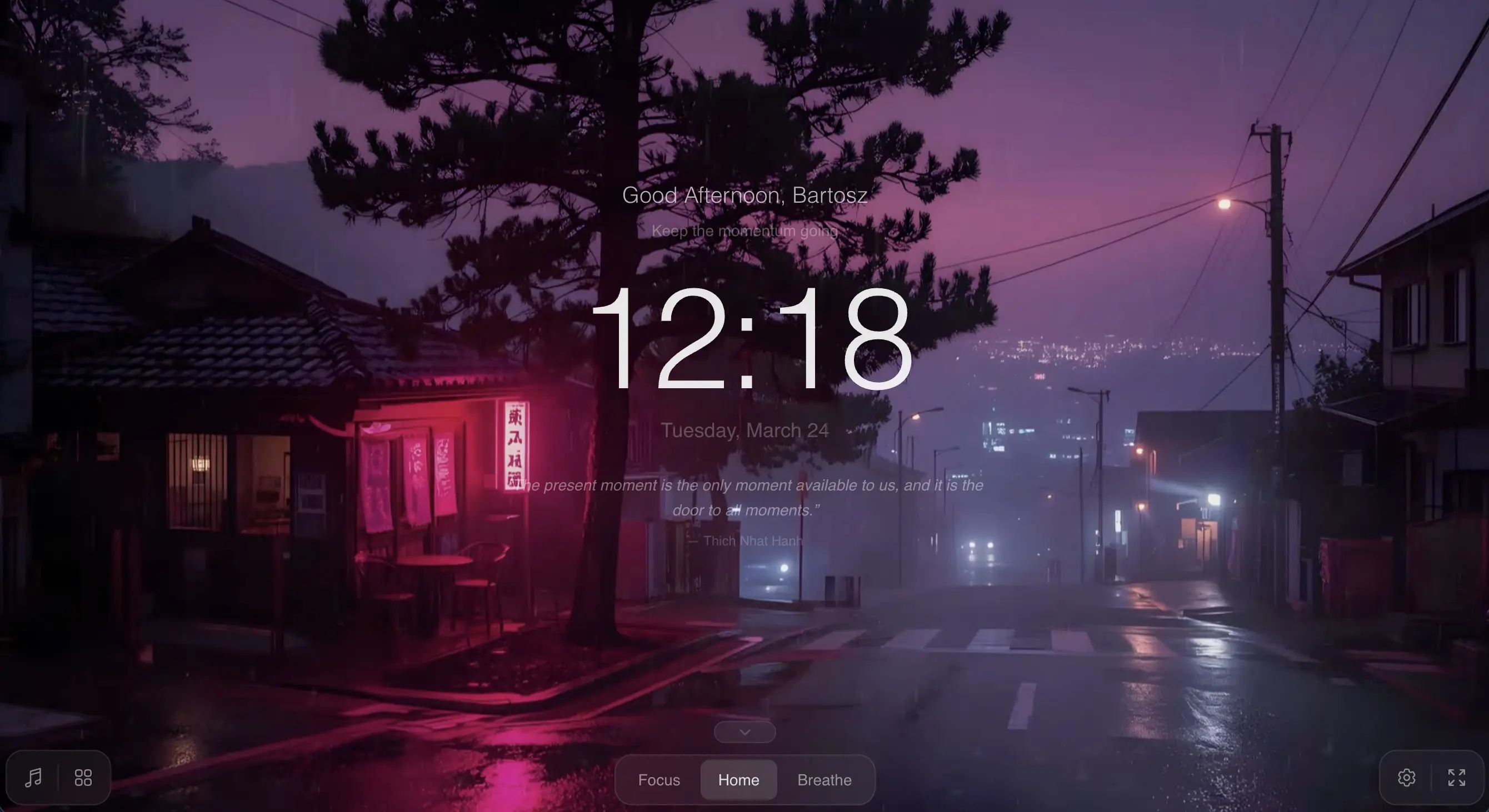
What Is breathclick?
A wellness and productivity web application that combines three disciplines into one seamless, deeply customizable experience.
Breathe
Guided breathing techniques — 4-7-8 Relaxation, Belly Breathing with rhythm variants, video-guided experiences. Animated visual guides, configurable cycles, session tracking.
Focus
Three timer engines: classic Pomodoro, Ultradian Rhythm, and Flowtime with mood-aware feedback. Integrated task management with emoji and color-coded priorities.
Experience
Engaging, immersive workspace for productivity and recovery that blends beautiful themes, lo-fi music, ambient soundscapes, and subtle micro‑interactions into one cohesive environment designed to support focus and calm.
Project Stats
Tech Stack
Working with Claude Code
A month on the Pro license was challenging, but paradoxically it helped maintain a relative work-life balance (more on that in the next section). After a short prompting session, I'd hit the rate limit and get locked out. Those enforced four-hour pauses were the only thing keeping my work pace in check. The restrictions eventually became too frustrating to ignore, so I started looking for a workaround. I came across a solution on X.com — a specific prompt that dramatically extended my sessions and let me bypass the previous limitations.
I'd like to avoid you scanning a thousand files at the start of every session,
so our work will be more efficient. Create a .claudeignore file in the project
root. It should work like .gitignore — but tell you what not to read. E.g.:
- directories: node_modules/ dist/ build/ .next/ coverage/
- files: package-lock.json, yarn.lock, *.min.js, *.log

In CLAUDE.md, point to where the code lives:
Project structure:
- src/ — application code
- public/ — static assets
Ignore everything else.
A month was enough for me to invest in the highest tier license without a shadow of doubt. Anthropic's new tools have been a complete paradigm shift for me — an evolution of my workflow that made going back to the old ways of building products simply unthinkable.
Mental Health & Personal Life
As someone who has spent four years professionally working on mental health projects, I observe with great mindfulness the impact that working with Claude Code has had on me. I noticed in myself a specific kind of productivity addiction. The sense of unlimited possibilities colliding with the physical limits of the body creates a dangerous, yet extraordinarily exciting paradox.
I'll admit it — I experienced insomnia born of pure excitement. The cost of going from concept to working prototype dropped to a level that guarantees instant gratification. The dopamine loop is a real phenomenon that relentlessly takes its toll: the lightning-fast conversion of a prompt into ready-to-use code triggers a creative euphoria and a sense of "superpowers" that's hard to describe to someone who hasn't felt it. The technical barriers that had previously kept ambitions in check simply ceased to exist.
The side effect? A tendency to pile on too many projects at once. My portfolio has grown by dozens of domains — each bought on the impulse that this is "the one project that will change everything." Working on new features until dawn became the norm, because shipping them is so effortless it's hard to tell yourself to stop. The moment of clarity arrives suddenly — the day your loved ones start asking whether you still belong to their world.
Neglecting relationships is a price you pay almost unconsciously — until someone brings it to your attention. So this post is, above all, my "I'm sorry" to the people close to me who are reading it. I know this is another passing hype and a new obsession that consumed me, but I promise that from now on I'll be more present in your world, not just my own.
The Evolution of the Product Manager Role
Early 2026 marks a critical moment in the history of software development, where the traditional barriers separating product vision from technical implementation have almost entirely dissolved. The traditional PM work model, based on creating static PRD (Product Requirement Document) documents, is becoming an anachronism. This shift forces PMs to think in systems and architectural terms from the very beginning of the ideation process.
When a PM can suddenly code and an engineer can design and define product success, traditional role divisions blur. Every team member starts believing they can do everyone else's work, leading to cultural tensions but also to an unprecedented fluidity of roles.
As Claude Code takes over the technical aspects of implementation, competencies previously reserved for experienced IT architects are gaining in importance. The Product Manager role is evolving towards that of a business architect — requiring deep understanding of the strategy, vision, and systems that underpin the organisation. The ability to design systems is becoming more valuable today than fluency in any specific language's syntax.
By building my first original end-to-end product, I feel fully legitimised in changing my LinkedIn headline from Product Lead to Product Architect. I feel this is my new path forward — at least for the next two weeks, until the next AI revolution changes the rules of the game again.
Product Manager is evolving into Product Engineer... It's super effective!
What's Next
breathclick is evolving from a personal project into a B2B2C product — a model I have commercial experience building in. The vision is to bring wellness tools into workplace environments, offered through employers to their teams, and the application’s architecture has already been deliberately designed for this next stage: scalable, multi‑tenant and ready for enterprise use. The current foundation supports future extensions such as i18n/l10n for multilingual deployments, fine‑grained ACL and role‑based access control, robust media asset management pipelines, and an event‑driven setup ensuring smooth expansion of asynchronous features. It’s also prepared for SSO integrations, observability tooling, feature flagging, API‑first partner integrations and flexible tenant isolation — all making the platform ready for the demands of a mature digital product.
The current challenge? Building an effective marketing page. In 2026, with AI‑augmented development, creating the product itself is the easier part. Cutting through noise, communicating value, and acquiring users — that’s where the real work begins. And since you can't optimize what you don't measure, the next step is plugging in PostHog to actually see what works and what's just wishful thinking. But to stand out, the page also needs a unique, intentionally crafted design that doesn’t look like yet another layout generated from a simple prompt...but the day only has 24 hours, and spring is in full bloom — logic and dignity suggest that a walk in the park is a better choice than another hour in front of the screen.